Wednesday, May 8, 2013

Good Reads: novels about Leonardo


detail from the ceiling of the Palazzo Zuccaro, Florence


Historical novels are among my favorite indulgences.  Recently, I've read Lucille Turner's Gioconda.  A recommendation from Martin Kemp in one of his books (or was it a talk) set me to looking for this.  The treatment is poetic.  She weaves bits from the notebooks, descriptions of the Italian countryside, imaginary thoughts and conversations, into a narrative that rolls along like felt time.  I was a bit annoyed at the anachronisms, but laughed heartily at the ending, relieved to not have to read yet another account of his possible despair at his death at not finishing much.  But since they were about twenty odd years apart in age, surely it is unlikely Leonardo played with Lisa of the famous portrait when they were children.  I'm not giving anything away here for those who haven't read it; the book begins with that.  Another sort of disruption in the otherwise enjoyable story is exemplified in the misunderstanding of how one would go about making the clay sculpture from which a giant bronze horse would be cast.  A huge block of clay cut into?  No way.  You need an armature, and you need to build it up over that, not carve it down.  And since she has them wetting the clay it obviously isn't plastilina.  Terra cotta would need to be fired. Here the need for it to be hollow becomes obvious.  Solid clay would explode in the firing, if you could even get an adequate temperature around such a thing.  And if not fired it would melt in the rain long before anyone got to shoot it to bits.  And it would slump in the firing and shrink 10% when drying.  If not fired, drying would cause it to crack to pieces if solid. But even if hollow it couldn't hold up under its own weight.  But these are minor complaints.

So this is why I have trouble reading some historical novels.  I want to make adjustments.  I want technical exactness in the art making.  I want someone to do for Leonardo what Irving Stone did for Michelangelo in The Agony and the Ecstasy.  Nearly a thousand pages, tiny type, and thoroughly researched, that novel filled my mind for 1 1/2 years as I read it one or two tiny chapters at a time every other night.  That was back in High School and the first year that I was a college student.  I felt like I was living in Renaissance Florence.  Why didn't Irving Stone do Leonardo?  Surely he is just as interesting as Michelangelo or van Gogh (Lust for Life).  If I find myself unemployed, without anything to do (ha) perhaps I will tackle it some day.

Other novels of Leonardo include Leonardo's Swans, which is more about the d'Este sisters than Leonardo, and The Memory Cathedral, a sci-fi story about the lost years (years in Leonardo's life that are missing in the documentary evidence of the time.)  It has some disgusting and some gruesome parts.  I won't spoil it with details, but I suspect there is some realism in those, alas.  The bad behaviour is not on Leonardo's part, unless you fault his lack of response.

I've also recently read Ken Follett's Fall of Giants.  This is not something I would have purchased but a friend sent it as a gift.  Before she sent it I'd debated in my mind whether to get it because I had greatly enjoyed his saga of the coming of the Gothic age to England in the series that began with Pillars of the Earth.  But this new one took place during WWI.  I was surprised that I found it absorbing.  You want the people to survive, to return to each other, to reconcile their differences.  It weaves personal stories and historical action more believably than the medieval novels, but both series have that strength.


Sunday, March 17, 2013

More melancholic musings over the obsolescence of the artist

The computer drew this the other day

I drew this long ago, age 18.  

I’ve recently seen a video of a robot that draws the customer’s portrait on the foam of their latte.  The video is described as a machine that can “print art on top of a cup of coffee” with no scare quotes around ‘art’.   Does the public not make any distinction between this and a painting? Anyway, the computer looks at you, decides what’s important to draw to make your face, and “expresses” this onto the foam with food coloring.  I can at least appreciate the punning.

Another video demonstrates 3D printers that can print out a guitar.  Bye-bye, luthiers?  It also prints records.  When recorded music became an easily obtained commodity the playing of musical instruments became much less common.  Can we imagine a time when music is something you listen to but no one makes music anymore?  When it is composed and created by machines with programs to produce whatever style and set of sounds you wish. Photography had once seemed to pose such a threat to art, but there was a difference.  Behind the camera was an eye selecting and then hands developing, manipulating, and printing the image.  It was as we say just another tool with which to create.  But computer-made computer generated images remove the need for the human eye and hand. I am not talking here about digital imaging, with the computer as a tool.  I am referring to computer programs that generate the image entirely without human instruction or intervention.  You might think that the writing of the program was the creative part.  But that would be akin to saying the designer of the urinal, not Duchamp, was the creator of Fountain (1917), another once-seeming threat to the nature of art.  But Duchamp’s ready-mades merely altered the material act and left the artist’s invention/intervention intact.  Yes, the viewer completes ‘the creative act’, as Duchamp’s essay by that name contends, but the artist remained as the ‘medium’ or mediator between the physical object and the viewer’s experience.  In the case of the computer generated image or object, there is no actual artist, or perhaps there once was (the designer of the program) and now there is no need of another for further ‘art’ to be made.  The computer robot can just keep making variations.  In a world already saturated with images and objects, will there no longer be a need for human activity to create more? 

It would be interesting to find out if the widespread use of creative media that do much of the designing, thinking, and facture for you has led to a decrease in interest in art as we have known it.  That is, will playing with programs on your computer lead to fewer visits to museums, reduced interest in musical performances (not just production of music at home but attendance at concerts).  Most concerts and performances I attend have many empty seats now, and the audiences are mostly grey-haired.  Will fewer people feel a need to attend art school?  Or will some 20th century ideas of life becoming art, removing the need for something set aside as special called Art, become reality? 

Since I wrote the above, the CAA newsletter linked me to an article in the Guardian that laments the demise of white-collar work and that of the creative classes.  It seems there are also computer programs that can analyze legal contracts and others that read medical data and diagnose better than human doctors.  It looks like humans may become obsolete.  Here is a quote that shows I am not the only one sensing a problem here:

“It may still be some time before robots are writing novels or painting pictures, but it is striking how many of the UK's most high-profile creative industries have already been automated. In music, for instance, it is disquieting how easy it now is to produce a record of commercial quality. To learn to play, let alone compose, a piece on the guitar or piano would take most people years of dedicated effort. But with readily available software on a standard laptop, and a few days of instruction, it is possible for bedroom record producers to generate and aggregate all the components of a perfectly reasonable pop song.”    (“The End of the Creative Classes is in Sight” by Tom Campbell)

There still are people who can, for example, hand-craft the equivalent of a Stradivarius violin, but what will become of such trades when there is no one who bothers to learn to play because a machine can synthesize the sound and even vary the interpretation so you can listen to an infinite number of ‘performances’ without anyone having to spend tens of thousands of hours practicing with care and dedication?  Apply this to everything we do and we are not really talking about ceasing to make buggy whips and building auto ignitions instead. Even decision-making has been automated, e.g. financial advice.  What will there be left for people to do? 

I do realize that the computer programs for creative design, or performance, or writing, or the grading of writing in lieu of teachers, do not yet imitate the quality of human work.  And this is not about using design programs with the computer as a tool for the designer.  This is about the computer doing the design without a human.  The threat is still in the future, but some effects are growing now. 

Am I foolish for worrying about this?   

Now I just found out that an MIT prof has done a TED talk on the same worries.


Sunday, March 3, 2013

Are Artists Obsolete?


Several years ago a couple artist friends and I were at the mall.  There was a photo booth that did your portrait in the style of (select one: Rembrandt, Renoir, Ingres, ...).  "We might as well just quit now," one of them moaned as a digital hand moved a digital pencil and drew examples.  Walter Benjamin could not have foreseen this when he penned his famous essay "The Work of Art in the Age of Mechanical Reproduction."  That was worry over reproduction, after all, and this was . . .  creation?  Why not; computers now write poems and novels, play chess, suggest restaurants you might like, and even can draw pictures of your thoughts or identify words you are thinking.  So why don't we just quit now?  What is there for a person to do that isn't automat-able?

The memory of that moment came to me when my old computer started to fall apart, requiring a replacement.  The new one came with new toys preloaded, including one called "Photo Booth."  It works a bit like the one in the mall except the only specific artist in the selections is this one illustrated above, called 'Pop Art', but obviously it is like a Warhol.  May I have my 15 minutes of fame now?

There were other ways to shoot oneself with this app, or whatever you might manage to get in front of the computer.  At first I thought this was some scheme to appeal to narcissists (maybe I can get the cat to pose) because it seemed the only thing this was good for was self-portraits.  So I tried the drawing version:


This caught me in profile and set me to remembering a page in my earliest hardbound sketchbook from the early 70's (my teen years).  So I hunted it down and photo'd it (above).  It is from near the end of the book and so I am around 19 or 20.  I did not own a camera at the time, and xerox machines did not yet exist.  So to get this profile, two mirrors had to be set just right so that looking into one I could see my profile.  It appears that the claim that one's nose continues to grow must be true.  The mechanical drawing is decades later.  The old sketch was done very quickly and is marred by transfer from the opposing page and stuff bleeding up through like a palimpsest. But clearly the nose is shorter but much lumpier in the old sketch.  Was I imagining that or exaggerating what I saw as a fault?  The human-made sketch records perceptions that the photo can't, even given that there are decades between the renditions. The computer -made drawing has the illusion of being more accurate, but don't believe it.  Every attempt at a photo looks different, sometimes like a completely different person.  The insistently slanted lines get boring after a while. Humans when they draw well vary their line direction and quality, and can thereby get a more interesting and expressive result.  So far.  

This notebook page set me to thinking about other occasional self-portraits I've done over the years.  Nostalgia set in and I flipped through some old boxes of drawings.  I will post some and continue thinking in my next post about the question of whether artists can be replaced by automation the way many other occupations have been. 

Sunday, January 20, 2013

Adventures in luthiery - themed dulcimers


Luthiery is the art of making plucked and strummed stringed instruments, though some include the bowed strings in that category also.  I started out many years ago making instruments in the foolish hope of finding work that would be appreciated for its usefulness.  Like Flaubert, I was torn between a love of art and a yankee (or was it Scottish) inclination toward austerity and practicality.   I thought luthiery would satisfy the drive to design and make things.  This was a mistake, of course, because I put so much time into making them interesting that I could not possibly earn a living.  I made a classical guitar and started a violin, but the predetermined form bored me.  The dulcimers offered an opportunity to design more freely, and so I continue to make them once in a while.  The latest in progress is related to the drawings from last summer of Verrocchio's putto fountain (June or July 2012). It will have a putto dancing on the peghead holding a small instrument instead of the dolphin.  This will work well with the traditional heart-shaped sound holes.

These illustrated above are older instruments made many years ago.  The Scottish Lion dulcimer was inspired by an incised image on a rock in Scotland from prehistoric times.  The sound holes are drawn from the Scottish flag.  The peghead, fingerboard, sides, and back are made of walnut wood,  the pegs are rosewood, and the soundboard is Englemann spruce.   I think I may have misspelled that.  They are entirely make with handtools.  The back is slightly bowed and the seam worked until you could not see a single ray of light through it when held together dry.  The joint is invisible except that the grain suddenly turns into its mirror image.  So the whole thing took 3 weeks to make working almost full-time.  I seem to have a habit of seeking out labor intensive projects.

The Rascal is made with cherry with ebony pegs.  The sound holes are oak leaves and the acorn contrasts a nice smooth surface with the rough fur of the squirrel rendered with the marks of the gouge. The squirrels eyes are ebonized along with the interior of the pegbox and the vertical edges of the soundholes. The finish on both of these instruments is French polish, another difficult and time-consuming process.

I ultimately opted for teaching as a way to contribute to civilization and earn a living.  So now I can do as I wish when it comes to art without the need to earn a living by it.  With such freedom, I chose to spend more time with 'fine art' and not the craft of luthiery.  And now I need not consider the excessive time spent carving, building, drawing, painting, plucking strings, etc. except insofar as that simultaneous urge for utter simplicity wages war in my soul.  Leonardo said "It should be our pleasure that our days be not squandered nor suffered to pass away in vain, and without meed of honour, leaving no record of themselves in the minds of men", and "I wish to work miracles." The desire to leave a mark, something to be remembered by that is deemed admirable, comes up against the understanding that such desire, among others, is the root of suffering.  The Buddhist ideal is to leave this world with no evidence of your having been here.  "There are no footprints in the sky."  Perhaps that can wait for another lifetime.

Monday, January 14, 2013

Leonardo in a fossil rock - a pareidolon


The other day a friend called all excited over finding a fossil that looked like Mona Lisa.  She knew I liked pareidola, fossils, and Leonardo.   Here they were all in one.  Isn't it fun when nature paints a picture, or in this case carves one?   When I saw it I thought she was daft.  If that's Mona Lisa, the girl needs some help.  I see an old balding guy with a very bushy beard.  His hands are visible along the bottom, the left hand holds a large bone.  I was greatly relieved when the fossil finder called again to see how I liked the image of Leonardo in the pose of Mona Lisa. Or, she says, maybe it's Moses.  Either is more believable.  But to me the creepy crinoid eyes make him look like an alien.  

Wednesday, November 21, 2012

Four Cats Visit the Sites of Duccio's Maesta Altarpiece


This is a set of small canvases that started a series in which the settings of old paintings or prints, mostly Italian Renaissance, were stripped of their figures, and other people, or in this case cats, enter the spaces to look around like tourists visiting an alternate universe.  In this case, the four cats visit the place of the washing of the feet (upper left), the site of the denial of Peter (upper right), the appearance before Pilate (lower left), and in the lower right, Four Cats Eat up the Leftovers at the Last Supper.  They were painted many years ago and several years have passed since the last of the cats died in extreme old age. Tempus fugit and I am not getting things done.  I work constantly, but the fall semester is always a challenge.  This is a brief break and a bit of whimsy to keep the blog alive.  

Wednesday, October 10, 2012

Solitude and Lastingness


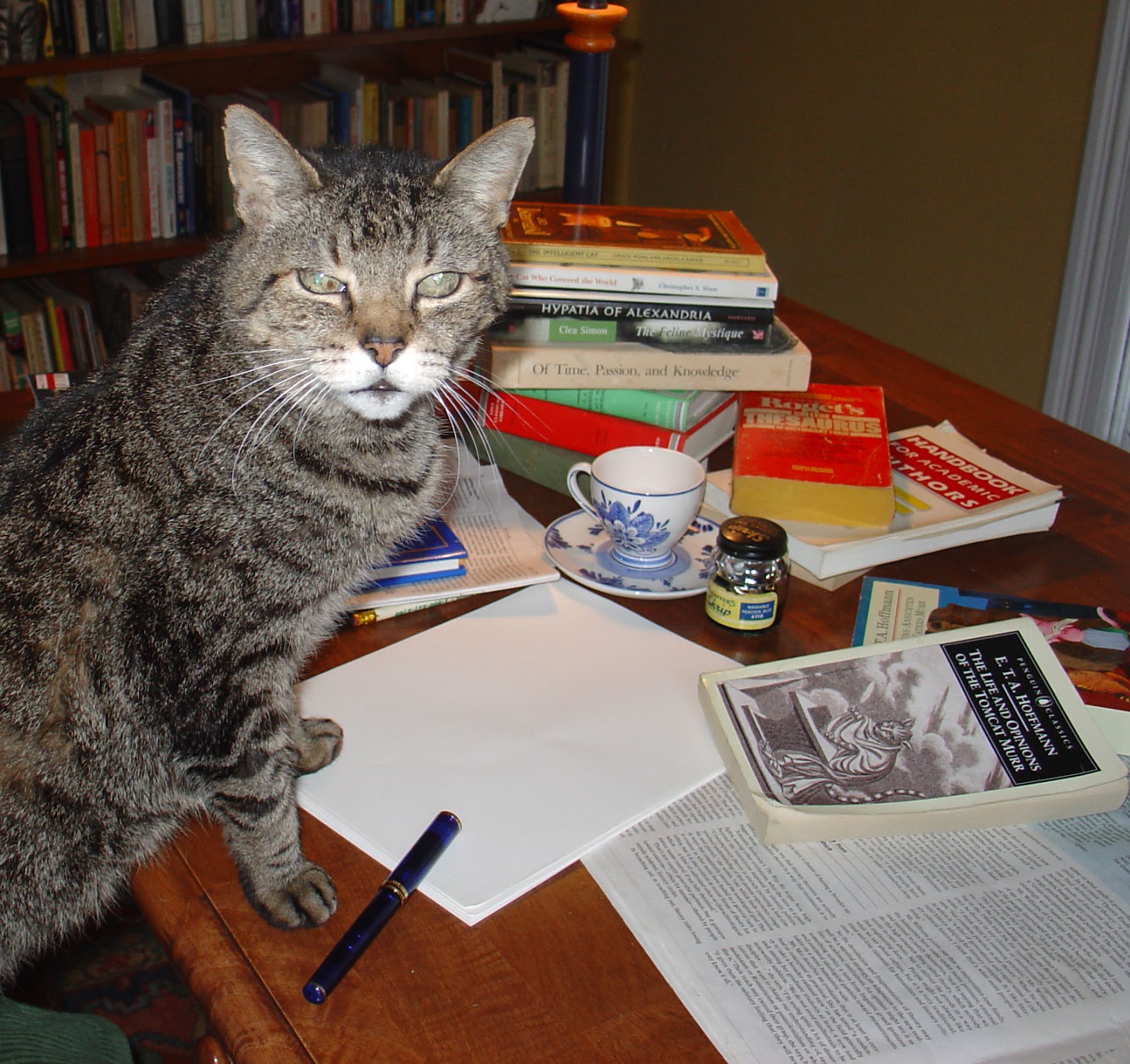
Here is Murr, my cat who died about 5 years ago, caught in the act of writing a book.  He was with me for 21 years, a large part of my life.  He was an intelligent cat and a good companion.  It's a commonplace that creative people prefer the company of cats to dogs.  Cats allow you to concentrate on work.  Usually.  My current cat, Leonardo, is good company too, but he doesn't quite measure up to Murr yet.  Leo is more demanding and Murr could keep you company while leaving you to do your thing. You could also say that Murr had lastingness, an intelligent and active kitty to the end.  He was the equivalent of 118 years old.

I've recently read two books, Solitude by Anthony Storrs and Lastingness by Nicholas Delbanco.  They had been on my to-read-some-day list for some time, but I did not know that one would speak to the other and quote it so much.  They both deal with the life of creative people.

Solitude investigates the need of some people for a way of life that most people today find puzzling and unattractive, and even judge it to be an unacceptable choice even for others, that is the inclination to be alone, to read, to think, to create, to make things or solve problems.  We live in a society that more and more values the outgoing charming personality and team activities over the introspective and solitary person.  Storrs inspects the lives of many famous creative people in history who would fall in that latter category.  He thinks the prejudice against such people may waste much of human potential.  You can see it in action when the college scholarships all go to those who can command leadership roles and win elections in the personality contests of political positions.  Emily Dickenson and even Albert Einstein would lose out in this competition.

The other book, Lastingness: the Art of Old Age, was about the question of creativity in old age.  The common wisdom is that new ideas and innovation in the arts and science are the work of the young.  We cease to create in mid life.  This is also just a cultural prejudice.  The many examples he explores can be inspirational, which is why I had it on my list.  I'm going to need to live to 100 and keep working to get all the work I have begun finished.  I need all the inspiration I can get. He also looks at the opposite situation, at some who lost it in later life but kept working anyway, like the poet Holderlin.  His life may have been better for his continuing to write poems, but the poems were terrible.  Still the numbers of great thinkers and creators whose work only got better and better are sufficient to blow away the false conclusion that decline is inevitable.

I am encouraged also by the example of Frank Lloyd Wright (my first hero--I told my mother when I was 4 that I was going to study architecture with him at Taliesen West, but he died the next year).  He was retired early after the scandals of his personal life, but returned to work at 55.  If he hadn't, he would only have designed some nice houses.  All his most famous and grander work was done after the age of 55.  And Hokusai is even more amazing.  In his notebooks he wrote that he drew obsessively since the age of 6, but nothing he did before the age of 70 was worth much.  And it's true -- his famous work was all done after the age of 70, including the Great Wave Off Kanagawa.  There is maybe time yet.